Saturdays.
“Now I think my own dissatisfaction with this apologue is that the effect is simply one of negation. It ought to excite some sympathy with what the author wants, as well as sympathy with his objections to something: and the positive point of view, which I take to be generally Trotskyite, is not convincing. I think you split your vote, without getting any compensating stronger adhesion from either party—i.e. those who criticise Russian tendencies from the point of view of a purer communism, and those who, from a very different point of view, are alarmed about the future of small nations. And after all, your pigs are far more intelligent than the other animals, and therefore the best qualified to run the farm—in fact, there couldn’t have been an Animal Farm at all without them: so that what was needed, (someone might argue), was not more communism but more public-spirited pigs.”
—Eliot rejects Orwell’s Animal Farm on July 13, 1944; Orwell mailed it on June 28, 1944, which—YO—way to speed-read there, T.S.
“That’s the point of being alone—it’s not anything to do with you. It’s about being something in someone else’s life, and no one ever knows the difference, or the truth. That’s why people like bad movies and bad fiction, and it’s worth it, it’s worth it, it’s worth it.”
—Sadie Stein
“Spreading messages dilutes them. Even understanding them is a compromise. The language kills itself, expires inside its host. Language acts as an acid over its message. If you no longer care about an idea or a feeling, put it into language. That will certainly be the last of it, a fitting end. Language is another name for coffin.”
—Ben Marcus, The Flame Alphabet
“For years my life wasn’t very peaceful and I couldn’t get quiet enough to detect those first intimations of a story. Some source of attunement had vanished. Or—just as likely—been suppressed to save me the pain of the conflict between the desire to pursue a story and the reality that every scrap of psychic energy was needed elsewhere. When I did start writing again it was in fits and starts, and that surprised me—I’d thought that beginning again would be like opening the sluice gates, years of stuff would come pouring through. Effortlessness is such a great dream! In reality the surveilling intolerance of perfectionism was keen as ever. But I was less scared of ferocity. I had the fantastic feeling of having less to lose. After all I’d just gone years without getting anything written—that was the real, and freeing, loss.”
—Elizabeth Tallent in Tin House
People my age
they don’t do the things I do
I can’t hear you
but I feel the things you say
I can’t feel you
but I feel what’s in my way
Now I’m floating
‘cuz I’m not tied to the ground
words I’ve spoken
seem to leave a hollow sound
Fuck, is this good.
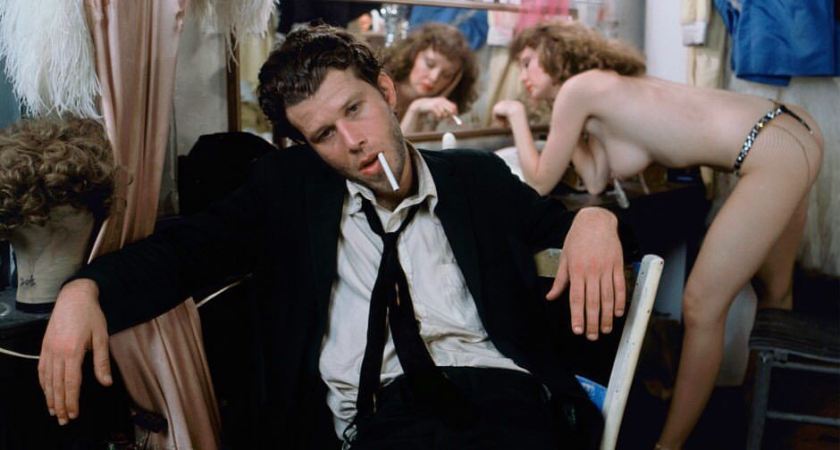
“Slouched about the small theater were other isolated men, squinting, yawning, some asleep under the sudden glare of the houselights. Tully waited in line at the lavatory, and when he came back to his seat the theater darkened and the maroon curtain jerkily parted. To the amplified music of a phonograph, the women came out one by one in velour and satin and sequined net, in floor-length gowns with grimy hems and long black gloves split at the seams. Middle-aged, they two-stepped across the stage, pulling off the gloves, pausing at the proscenium to expose a mottled thigh and shake a finger at the audience for peeking. The gloves were tossed to the wings, the gowns dispatched, fringes rose and fell, waved and jiggled. Unclasped brassières were held in place while orange and platinum heads shook in coy demurring. Released, breasts descended, blue-white, bulbous, low, capped with sequined discs. Fringed girdles off, haunches flexed and sagged, satin triangles drove and recoiled. Calves sinewy, thighs dimpled, scars tucked in the fat of bellies, the women rocked and heaved, beckoned with tongues, crouched and rose with the edge of the curtain between their legs. Mouths open, they trotted out on the runway in high heels, squatted, shook, lay on the floor, lifted legs, caressed themselves, rose and ran off with coy little steps, wriggling dusty buttocks. Estelle appeared last, revealing meager breasts, sharp hipbones, and a belly that had lost its plumpness since the pictures outside were taken. There was nothing about it to remind Tully of his wife.”
—Leonard Gardner, Fat City
“‘Tell me all about it. I don’t care. It’s natural enough—you’re a healthy girl. I’m not jealous, I’m just warning you. Now, okay, forget it, I’m not mad, everything’s fine. For Christ’s sake, don’t cry. I’m not mad. What went on before me is your own business, and if anybody wises off I’ll bust his head. Didn’t you know he’d shoot his mouth off to everybody? That’s what I can’t stand—knowing that son-of-a-bitch is laughing about it. I’m going to kick ass royal around this shit town. Will you stop crying? I told you I’m not mad. Can’t you understand that? Maybe you loved him, I don’t know, though I don’t see how you could, but maybe you did. I know you got urges. It wouldn’t be right if you didn’t.’
She uttered a wail of such resonant grief, loud and deep like an inhuman moan, that he was frightened.
‘Faye?’
She was silently rocking. From between her fingers tears dropped to the sheet. Again that deep animal moaning, terrifying in its immodesty, rose from behind her hands. It was a sound he had never heard before. He sat up, rigid, staring at her bowed head, her clenched and digging fingers, saying: ‘Faye, it doesn’t bother me, it doesn’t bother me. It really doesn’t bother me. Faye, it doesn’t bother me at all. It really doesn’t bother me.’”
—Leonard Gardner, Fat City
“‘It wanting that do it. You got to want to win so bad you can taste it. If you want to win bad enough you win. They no way in hell this dude going to beat me. He too old. I going be all over him. I going to kick his ass so bad, every time he take a bite of food tomorrow he going think of me. He be one sore son-of-a-bitch. He going know he been in a fight. I get him before he get me. I going hit him with everything. I won’t just beat that motherfucker, I going kill him…. You want to know what make a good fighter?’
‘What’s that?’
‘It believing in yourself. That the will to win. The rest condition. You want to kick ass, you kick ass.’
‘I hope you’re right.’
‘You don’t want to kick ass, you get your own ass whipped.’
‘I want to kick ass. Don’t worry about that.’
‘You just shit out of luck.’
‘I said I wanted to kick ass.’
‘You got to want to kick ass bad. They no manager or trainer or pill can do it for you.’
‘I want to kick ass as bad as you do.’
‘Then you go out and kick ass.’”
—Leonard Gardner, Fat City
 Health + Youth