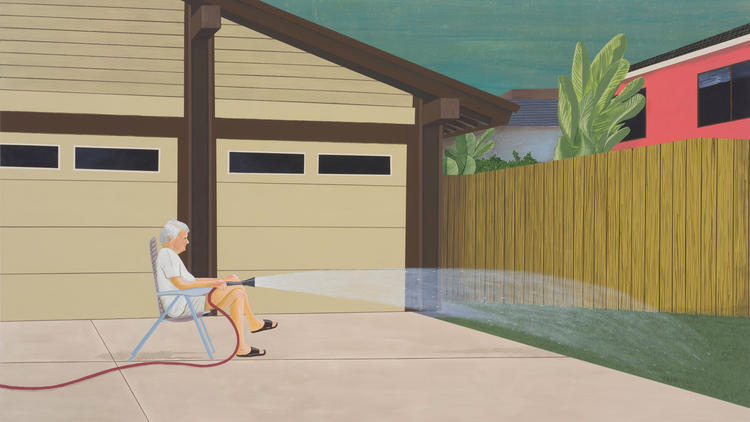
“At Roberts” by Ed Templeton
“At Roberts” by Ed Templeton

“This Rain” by Agnes Martin.
Issue No. 153
EDITOR’S NOTE
Sometime after I’d read and fallen for Jonathan Durbin’s “Dad Thing,” I learned from his cover letter, which I had skipped over, that he’d taken inspiration from Raymond Carver’s “What We Talk About When We Talk About Love.” I’ll admit I didn’t notice the allusion on my own, but the nods became immediately clear: drinks around the kitchen table or island, gin or scotch, the rhythms of conversations had over those drinks, the search for meaning in past violence and trauma.
Equally clear was how such an homage often means more to the writer than it does to the reader, because Durbin has built the inspiration he gained from “What We Talk About When We Talk About Love” into something else, something unrecognizable as Carver because it is so essentially Durbin.
Carver’s is a rare case of the title’s notoriety surpassing the story itself. The title, which was actually Gordon Lish’s, acknowledges that when we talk about love, what we talk about is not love, or at least not quite. In “Dad Thing,” Bill and his high school friends Neal and Soraya discover that what we talk about when we talk about fatherhood, or marriage, or illness, or friendship, is not any of those things but the evidence of them, which is as often unpleasant (or devastating) as it is pleasant.
In Neal’s case, his desperate performance obscures the true subject of conversation. Bill is in L.A. visiting his hospitalized father, and though Bill and Neal haven’t seen each other in years, Neal insists on touring him through a maniacal renovation of his already magazine-quality house. “She’s going to love it,” Neal says of his absent wife, who possibly has no knowledge of the work being done. And of his three-year-old son’s bedroom he says lecherously, “It’ll make the girls weak in the knees. I’ll have to supervise when his girlfriends come to play. ‘No sleepovers until you’re eight.’”
Bill makes a good audience, as do most people who keep their opinions to themselves. But as Neal and Soraya carry on, Bill’s thoughts display a depth of feeling that their words do not: “One time after school my senior year I came home and found my dad’s Audi parked in the driveway, my dad sitting behind the wheel,” Bill recalls, “… still belted into the driver’s seat of his convertible, hands on the wheel at ten and two like he was thinking hard about driving someplace else.” His father might have gone anywhere, but he didn’t and so Bill doesn’t ask where he wanted to go, and one senses that a moment that contained a real possibility for connection has been passed over. With “Dad Thing,” Durbin asks if we notice those moments only in retrospect, or if we can catch them while they’re fresh, and still full of possibility.
Halimah Marcus
Editor-in-Chief, Electric Literature’s Recommended Reading
Support Recommended Reading
All Donations are tax-deductable
Dad Thing
by Jonathan Durbin
Original Fiction
Recommended by Electric Literature

My first night back in L.A., I went to Neal McDonagh’s house because he said he wanted to talk. Neal is a sports agent now. He handles celebrity athletes, spends his days dealing with all these celebrity concerns. I wasn’t planning to visit him, but he found out I’d be in town to see my dad and dropped me a line. So I had to go over. Neal and I grew up together. We’ve known each other too long for me to slip in and out of L.A. without stopping by.
The two of us stood around his kitchen island drinking scotch. The kitchen island was draped in tarp and the floor was covered with brown paper. He had a TV crew in to renovate his house, the one he owned in the Palisades, and everything in there crinkled to the touch. It was a beautiful place, a white modern box with frosted-glass picture windows, blonde-wood accents in the interior. I know; I’d seen it before. After he and Heather first moved there, I flew in for the housewarming party. But that was five years ago. Neal and I weren’t as close anymore. New York kept me busy. I hadn’t even sent him a note when he and Heather had their boy. I found out about Max the same as strangers did: Facebook.
“Wait until you see him,” Neal said. “You’re going to think Max is so handsome. He’s such a good-looking kid.”
“I hope I get to,” I replied.
“I hope you do too. How long are you in town, Bill? How long can you stay?”
“Don’t know yet. Maybe a week.”
“I wish you were here longer. But I get it. I understand. I can’t imagine what you’re going through. How is your dad?”
I rubbed my mouth and hoped whatever I said sounded believable. I didn’t want to get too far into that conversation. The hospital smell still clung to my fingers, sweet and heavy, like bad fruit. “Better,” I decided to tell him.
“That’s good.” He nodded deep as though he believed me, as though encouraging me to go on. But between the delay at LAX and traffic on the 405 and then spending the afternoon with my father, I didn’t feel much like expanding. I didn’t even want to be in California. I looked around his kitchen. I saw the holes in his walls, the insulation stuffed up against his baseboards.
“So when did all this happen?” I asked.
Neal grinned. “Wait until you see what they’ve done.” He began to pace, tracking plaster dust across his brown paper floors. “You won’t believe it. This house is going to be famous. This house is going to shine.”
Neal’s tall and thin, with thick black hair cropped tight at the temples. He hadn’t changed much since high school. He still liked sports watches with gold links and playing around with stereo equipment. He’d wired his duplex so he could use his phone as a remote. Right then we were listening to hits from the nineties, all these rappers I barely remembered. He commented on them, what happened to Eazy-E and ODB and Tupac and Big Pun—how hard they’d all been, how sad they’d all turned out. Then he started in about fatherhood. Neal said having Max saved his marriage. He said since he’d become a dad he and Heather were better than ever. They’d quit the drugs. They weren’t trying to kill each other with good times anymore.
“You’re going to love Max’s room,” he continued. “It’s probably the size of your whole apartment.”
I laughed. “Probably.” I drained my glass and set it down on the tarp.
“You’re going to wish you had a room like it when you were a kid.” He stared at me. It took him a while to blink. “I’ve been dying to show it to you. I’ve been dying to show you everything they’ve done.” Neal pointed at my tumbler. “You want another?”
I said yes even though I didn’t like this scotch. It was full of peat and smelled like sore-throat medicine. But Neal said he bought it to celebrate my being home. I couldn’t turn him down.
“You know you’re welcome to stay whenever you like. Whatever the reason.” Neal inhaled. “Soraya’s slept over a few times.”
“She always liked to hang with you,” I said.
“I never let the good ones go.”
“Heather’s all right with that?”
“God, yes. They’re close.”
“What does Heather think about the renovation?”
“She’s going to love it.” Neal pursed his lips. “It’s my gift to her. Sort of.”
“That’s nice. Must be expensive.”
He shook his head. “It’s paid for. Besides, it’d be more expensive if I didn’t do it.” He laughed. “You don’t even know. Soraya’s been helping me out with the décor. She’s been helping me decide what Heather would like.” He tossed back the rest of his drink and his face went tight. “Soraya wants to see you, by the way. I invited her over. But don’t worry. I told her you were in rough shape.”
“One time after school my senior year I came home and found my dad’s Audi parked in the driveway, my dad sitting behind the wheel. I waved at him but he didn’t wave back. I went inside and did some homework and screwed around on Nintendo and called people on the phone. Then Neal came over to pick me up in his Jetta so we could go cruise Melrose or Sunset and talk to girls the way we always did, and when I left the house I saw my dad sitting there, still belted into the driver’s seat of his convertible, hands on the wheel at ten and two like he was thinking hard about driving someplace else.”
From “Dad Thing” by Jonathan Durbin, recommended by Electric Literature. Read it for free tomorrow in Electric Literature’s weekly fiction magazine, Recommended Reading.

“Hold” by Jessica Wohl
“7.7 But on this thought’s outer reaches lay a much less reassuring counter-thought: what if it were just a circle, spinning on my screen, and nothing else? What if the supply-chain, its great bounty, had dried up, or been cut off, or never connected in the first place? Each time that I allowed this possibility to take hold of my mind, the sense of bliss gave over to a kind of dread. If it was a video-file that I was trying to watch, then at the bottom of the screen there’d be that line, that bar that slowly fills itself in—twice: once in bold red and, at the same time, running ahead of that, in fainter grey; the fainter section, of course, has to remain in advance of the bold section, and of the cursor showing which part of the video you’re actually watching at a given moment; if the cursor and red section catch up, then buffering sets in again. Staring at this bar, losing myself in it just as with the circle, I was granted a small revelation, it dawned on me that what I was actually watching was nothing less than the skeleton, laid bare, of time or memory itself. Not our computers’ time and memory, but our own. This was its structure. We require experience to stay ahead, if only by a nose, of our consciousness of experience—if for no other reason that that the latter needs to make sense of the former, to (as Peyman would say) narrate it both to others and ourselves, and, for this purpose, has to be fed with a constant, unsorted supply of fresh sensations and events. But when the narrating cursor catches right up with the rendering one, when occurrences and situations don’t replenish themselves quickly enough for the awareness they sustain, when, no matter how fast they regenerate, they’re instantly devoured by a mouth too voracious to let anything gather or accrue unconsumed before it, then we find ourselves jammed, stuck in limbo; we can enjoy neither experience nor consciousness of it. Everything becomes buffering, and buffering becomes everything. The revelation pleased me. I decided I would start a dossier on buffering.”
—Satin Island, Tom McCarthy

“Edie Sedgwick” found a new home. [Nashville Review]








 Health + Youth