
–Nashville Review, summer 2014. “Edie Sedgwick.”
–Nashville Review, summer 2014. “Edie Sedgwick.”
“The neighbors wanted stacks of ‘Missing’ posters for every person they lost, even themselves. Missing: former self. Distinguishing marks: expectations of fame, ability to demand love. Last seen wearing: hopeful expression, uncomfortable shoes.”
–Elizabeth McCracken, “The Lost & Found Department of Greater Boston”
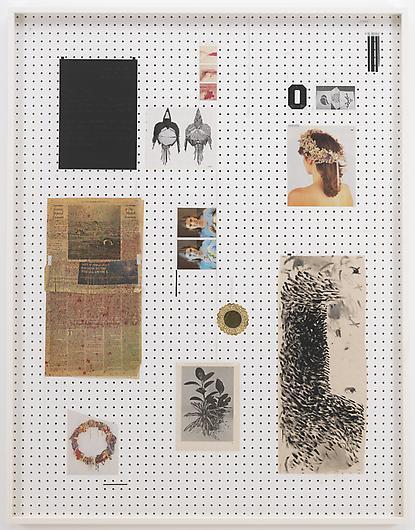
—"Untitled Still Life (Wreaths and Masks),“ Amanda Ross-Ho
“Isn’t everyone on the planet or at least everyone on the planet called me stuck between the two impulses of wanting to walk away like it never happened and wanting to be a good person in love, loving, being loved, making sense, just fine? I want to be that person, part of a respectable people, but I also want nothing to do with being people, because to be people is to be breakable, to know that your breaking is coming, any day now and maybe not even any day but this day, this moment, right now a plane could fall out of the sky and crush you or the building you’re in could just crumble and kill you or kill the someone you love—and to love someone is to know that one day you’ll have to watch them break unless you do first and to love someone means you will certainly lose that love to something slow like boredom or festering hate or something fast like a car wreck or a freak accident or flesh-eating bacteria—and who knows where it came from, that flesh-eating bacteria, he was such a nice-looking fellow, it is such a shame—and your wildebeest, everyone’s wildebeest, just wants to get it over with, can’t bear the tension of walking around the world as if we’re always going to be walking around the world, because we’re not, because here comes a cancer, an illness, a voice in your head that wants to jump out a window, a person with a gun, a freak accident, a wild wad of flesh-eating bacteria that will start with your face.
"But my husband before he was Husband, being around him did, for a while, make me forget about my wildebeest. We walked around the city holding hands and we did a good deal of reflexive smiling and we often kissed and it felt like drugs that are too strong to legally exist outside of a body and there was that night the professor who became my husband smiled at me in the dark and i could see the pale white glow of his teeth and I thought there would never be anything better than seeing the pale white glow of his teeth through the dark on this night after we decided to get married and for at least a few minutes it made perfect sense and I believed that he had redeemed me and in a way he had and he did—but I don’t know why the wildebeests kept coming back, throwing all their angry weight around and making all those sweet, human, cracked-open, genuine, well-adjusted feelings go away, but they did go away—why did they go away?—I would like them not to go away and I would like to go back to being or feeling redeemed by him, by the glow of his teeth in the dark, by our skin against each other—What are you thinking? he asked me that night with his teeth, and I thought about what I was thinking about and I worried that I was slipping away from making sense, but I gripped hard on that sense and said, Oh, nothing, just how I love you, and I twisted my toes under the sheets and told myself to be a woman who lives normally, being loved and loving—and I could be her—couldn’t I? Couldn’t I?”
–from Nobody Is Ever Missing
One more.
Why not.
Watch Mark Lanegan’s recent KEXP in-studio performance, which includes two new songs from Lanegan’s album Phantom Radio, due later this year.
“I knew what he would say next, but I always listened intensely, as if I was trying to memorize his pain so I could re-create it once he was gone or dead or dead and gone, because I thought, at the time, that my husband’s loss was what I had really fallen in love with, and maybe that loss was locked up in my husband like a prison and this was our once-a-year meeting and so I had to press myself against the Plexiglas to feel the blood and body heat of his loss, stare hard at the loss so I could remember how its face was shaped, the exact color of its eyes, something to get me through the next year of living with my husband and not his loss, but the lack of loss, a bleached-out version of it, a numb heart that hosted something with a real pulse and wildness because my husband had only the most basic pulse and absolutely no wildness, but his loss was wild, was wild and filled with fast blood, and I could understand that angry bright red thing. I knew it was possible that I was not in love with a person but a person-shaped hole.”
—from Nobody Is Ever Missing
Why is this on bookstore shelves when “Rage” is out of print?
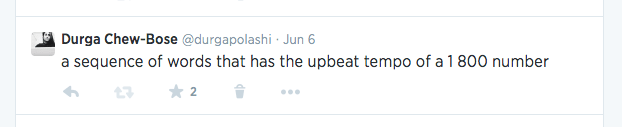
a sequence of words that has the temporarily strained but anticipated pop of opening a wine bottle
a sequence of words that rushes in but slowly recedes only to rush in again like waves at high tide
a sequence of words that alert you to something other than the thoughts in your own head like the delicate jangle of wind chimes on a neighboring porch
a sequence of words that are clumsy yet profound like subtitles in a foreign film
a sequence of words that are as expectant as a card trick yet quietly cruel like a poem
a sequence of words that pivot not once but twice, sometimes three times like the squeak of high tops on a wood court
a sequence of words that has the ruinous appeal of pouring hot coffee on ice
 Health + Youth