• Home
  • Press & Publications
  • Contact

Health + Youth

  • Rosemary

    August 16th, 2015

    Rosemary I’ve almost forgotten your name
    The tears on my face they don’t burn quite the same
    And I look in the mirror and your reflection’s not there
    Just the daughter of a man and a cold hard stare

    Rosemary my desire to hold you is deep
    And it keeps me from living and it keeps me from sleep
    Am I holding on so tight that my fingers might bleed
    If I let go of you now will you let go of me
    —Nina Nastasia

  • Lately

    August 16th, 2015

    Lately I’m not feeling like myself
    When I look into the glass I see someone else
    I hardly recognize this face I wear
    When I stare into her eyes I see no one there
    Lately I’m not feeling like myself

    Lately I’ve been losing all my time
    All that mattered to me slipped my mind
    Every time I hit another town
    Strangers appear to lock me down
    Lately I’ve been losing all my time

    The mystery that no one knows
    Where does love go when it goes

    Lately words are missing from now on
    Vanished in the haze of love gone wrong
    There’s no future there’s no past
    In the present nothing lasts
    Lately someone’s missing from now on

    The mystery that no one knows
    Where does love go when it goes
    The mystery that no one knows
    Where does love go when it goes
    —Lera Lynn

  • This horrorshow.

    August 16th, 2015

    “One ex-employee’s fiancé became so concerned about her nonstop working night after night that he would drive to the Amazon campus at 10 p.m. and dial her cellphone until she agreed to come home. When they took a vacation to Florida, she spent every day at Starbucks using the wireless connection to get work done.”
    — “Inside Amazon: Wrestling Big Ideas in a Bruising [Brutal?] Workplace” 

  • Lately

    August 15th, 2015

    It is a shame that such a fine song as “Lately” by Lera Lynn needs suffer for its association with HBO. Edit: although one supposes the exposure can’t hurt the artist.

  • August 15th, 2015

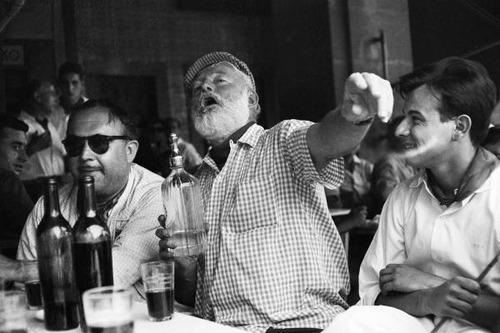
    Havana. [h/t @pkhakpour, via @veryoldpics]

  • How do you like it now, gentlemen?

    August 15th, 2015

    “Hemingway went back to the bookcase and stood there stiffly, as though he could not decide what to do with himself. He looked at the pasteboard backs again and said, ‘Phony, just like the town.’ I said that there was a tremendous amount of talk about him these days in literary circles—that the critics seemed to be talking and writing definitively not only about the work he had done but about the work he was going to do. He said that of all the people he did not wish to see in New York, the people he wished least to see were the critics. ‘They are like those people who go to ball games and can’t tell the players without a score card,’ he said. ‘I am not worried about what anybody I do not like might do. What the hell! If they can do you harm, let them do it. It is like being a third baseman and protesting because they hit line drives to you. Line drives are regrettable, but to be expected.’ The closest competitors of the critics among those he wished least to see, he said, were certain writers who wrote books about the war when they had not seen anything of war at first hand. ‘They are just like an outfielder who will drop a fly on you when you have pitched to have the batter hit a high fly to that outfielder, or when they’re pitching they try to strike everybody out.’ When he pitched, he said, he never struck out anybody, except under extreme necessity. ‘I knew I had only so many fast balls in that arm,’ he said. ‘Would make them pop to short instead, or fly out, or hit it on the ground, bouncing.’”
    —”The Moods of Ernest Hemingway,” Lillian Ross

  • August 9th, 2015

    Killer.

  • Directions.

    August 9th, 2015

    “[Rojas] took off her apron and sat down on a couch in a front room. She told me that she had recently taken a motorcycle-safety course, so she can ride a Vespa around Marin County on the weekends, and eventually use it in the city, to go from home to the studio. At the school, there was an obstacle course made out of cones. ‘One of the main things they teach you, going in and out, is not to fixate on the object in front of you, always to go straight ahead,’ she said. ‘I fixated on the thing in front of me for a really long time.’”
    —“A Ghost in the Family” by Dana Goodyear

  • A little autobiography and a lot of imagination are best.

    August 9th, 2015

    “The fiction I’m most interested in has lines of reference to the real world. None of my stories really happened, of course. But there’s always something, some element, something said to me or that I witnessed, that may be the starting place. Here’s an example: “That’s the last Christmas you’ll ever ruin for us!” I was drunk when I heard that, but I remembered it. And later, much later, when I was sober, using only that one line and other things I imagined, imagined so accurately that they could have happened, I made a story—“A Serious Talk.” But the fiction I’m most interested in, whether it’s Tolstoy’s fiction, Chekhov, Barry Hannah, Richard Ford, Hemingway, Isaac Babel, Ann Beattie, or Anne Tyler, strikes me as autobiographical to some extent. At the very least it’s referential. Stories long or short don’t just come out of thin air. I’m reminded of a conversation involving John Cheever. We were sitting around a table in Iowa City with some people and he happened to remark that after a family fracas at his home one night, he got up the next morning and went into the bathroom to find something his daughter had written in lipstick on the bathroom mirror: “D-e-r-e daddy, don’t leave us.” Someone at the table spoke up and said, “I recognize that from one of your stories.” Cheever said, “Probably so. Everything I write is autobiographical.” Now of course that’s not literally true. But everything we write is, in some way, autobiographical. I’m not in the least bothered by “autobiographical” fiction. To the contrary. On the Road. Céline. Roth. Lawrence Durrell in The Alexandria Quartet. So much of Hemingway in the Nick Adams stories. Updike, too, you bet. Jim McConkey. Clark Blaise is a contemporary writer whose fiction is out-and-out autobiography. Of course, you have to know what you’re doing when you turn your life’s stories into fiction. You have to be immensely daring, very skilled and imaginative and willing to tell everything on yourself. You’re told time and again when you’re young to write about what you know, and what do you know better than your own secrets? But unless you’re a special kind of writer, and a very talented one, it’s dangerous to try and write volume after volume on The Story of My Life. A great danger, or at least a great temptation, for many writers is to become too autobiographical in their approach to their fiction. A little autobiography and a lot of imagination are best.”
    —Carver, “Art of Fiction No. 76″
  • On narrowness.

    July 9th, 2015

    How do you imagine your
    book aging? Do you think of it as a snapshot of a specific time period, or will
    it be applicable and relevant even as technology and culture evolves?

    I have an unusual mindset about this. Rogert Ebert once wrote
    about a movie called A Separation, which won the foreign language Oscar
    a few years back. It’s an Iranian movie. His point was that it was a really
    detailed examination of Iranian social and political life. It’s
    not a broad allegory of anything, but because of that, the more specific in
    detail it becomes, the more universal it can eventually be.

    If my book is just a snapshot of a particular moment in time,
    which I hope it is, then people actually will refer back to it precisely for
    that reason. They will want to understand what the time was about and what it
    was like. If [the book] became too broad, it would portray biases that were inherent
    in my culture at the time. It wouldn’t actually mean anything. I tried to
    make it pretty narrowly focused on this one period in time while thinking, This,
    or something like this, will only happen once. So if you want to know what this
    interesting time of experimentation with media distribution and technology
    looked like, make it as specific as you can to that time because then it has
    potential to be a more definitive document of that time.

    I should say I don’t think I’ve done that. I don’t
    think I’ve
    completely succeeded. But the idea was to make it very specific and detailed
    about a particular period of time, because that’s much more interesting to me than
    these hifalutin concepts of “what does it all mean in the end?” There’s
    not very much of that in the book, actually. When it comes to the moral aspect
    of pirating, I want readers to ask if it actually is wrong. I don’t
    want to tell them.
    —“The Man Who Found the Man Who Broke the Music Business”

  • July 7th, 2015

←Previous Page
1 … 22 23 24 25 26 … 61
Next Page→

Blog at WordPress.com.


Loading Comments...
 

    • Subscribe Subscribed
      • Health + Youth
      • Already have a WordPress.com account? Log in now.
      • Health + Youth
      • Subscribe Subscribed
      • Sign up
      • Log in
      • Report this content
      • View site in Reader
      • Manage subscriptions
      • Collapse this bar