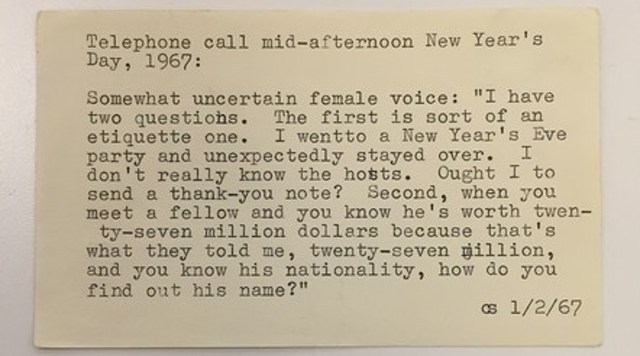
—"Before Google, Here’s What New Yorkers Asked the NYPL,“ Gothamist
—"Before Google, Here’s What New Yorkers Asked the NYPL,“ Gothamist
Speakeasy Hill, High Bridge, N.J., Jan. 1, 1990—The “Eighties” are finished; the new decade begins, although strictly speaking it really doesn’t start until Jan. 1, 1991, or so the purists maintain. Any way you look at it, though, the last year was a good one as far as my hunting and fishing went. As a matter of fact, the year was probably one of the best years I’ve ever had—full of luck, good times and better friends, and some of the best trips I have ever enjoyed.
Let’s see. While the year started out fairly disappointing with a siege of bad weather for our January quail hunt out in Tennessee and high winds for a February bonefish tournament in the Bahamas, things picked up in good fashion after that. We had a fine trip to Argentina in March and, while I didn’t shoot a stag myself, some of my friends—Joe and Rose Wells, Tim Crawford, and Lynn Smith—took nice heads on their first stag hunt on Douglas Reid’s estancia. We’re going back this year and, who knows, maybe I’ll pop a cap.
April was really one of the best months I’ve ever spent, as I spent most of it in Botswana and was lucky enough to have two splendid Cape buffalo hunts—one with Johnny Dugmore and the other with the famed Harry Selby (Bob Ruark’s old hunter, centerpiece of Horn of the Hunter and Use Enough Gun). I had fairly interesting experiences on both buffalo hunts and, as it turned out, the buff with Harry turned out to be 43", which is pretty good these days in Botswana.
We held our ninth Islamorada Irregulars Invitational Tarpon Tournament in the Florida Keys in May, and I am pleased and proud to say that all three members of the family competing—wife Jan, son Jim and me—took a tarpon, although Jimmy was sweating it out to the last day under the terrible pressure of possibly being the only family member to blank out. (This was doubly worrisome as his mother captured the ladies’ title!)
I took about 16 people down to Argentina for goose and dove hunting in June and, as usual, we had a splendid shoot. I won’t go into “body counts,” but let it suffice to say that all birds were utilized by the local orphanage, which is in desperate straits due to the economic crisis down there. Doves and geese are considered “vermin,” as they are in tremendous numbers (with no local shooting to control them) and literally ravage the grain crops. If you are looking for a bird shooter’s paradise—and like being welcomed as saviors by the farmers—Argentina is the place. The fact that they have the best steaks in the world adds to the atmosphere as well.
My fishing luck continued to hold for July when a bunch of us went down to try out the fabled sailfish and marlin fishing off the western coast of Costa Rica. It was even more fabulous than we had heard. Larry Ricca and I brought up 22 sailfish to the teaser, hooked nine and landed four in about five hours of actual fishing time. We took several on a fly after we had caught about 15 dolphin flyfishing. Our six other partners did as well or better during the three days of fishing there, including two blue marlin and one black.
We maintained our fishing momentum in August with a great trip to Alaska with Bobby De Vito at his Branch River Lodge, and continued our salmon fishing—for the Atlantic species—on the George River in Quebec in September. Once more I took about 20 guns to Botswana for our annual September bird-hunting foray in that country. Again, the dove (four species) and sandgrouse (three species) shooting was superb, with some fine francolin partridge gunning thrown in.
Things really picked up in October when we went out for our first “Cast and Blast” steelhead and chukar expedition on the Grande Ronde river in southeastern Washington (described in last month’s column). On the way home I stopped over in Grand Rapids, Minn., for the most incredible grouse and woodcock hunt I have ever enjoyed, in company with a local guide, Howie Hill, who is probably the best grouse man ever to follow a dog. I won’t go into a further description of that memorable three days as it rates a column all of its own, which will probably come to light in the April issue!
I headed home for some local shooting before taking a bunch of friends to Scotland for some driven bird-shooting—pheasant, duck and partridge—mixed with a day or so of what they call “rough shooting” for geese, snipe, grouse and wood pigeon. I had two groups, back-to-back, and the weather and hame cooperated beautifully.
On returning home we held one of our annual quail trips—two of them, back-to-back—at the Estanuala Hunt Club out of Brownsville, Tenn. Again, we had a great time with the weather holding and a lot of birds to flush and bag. I spent the whole time on horseback, and it was good to follow a fine brace of pointing dogs again. You can really cover ground and find birds. Jerry Williamson made sure we did that with his pointers Tina, Jet and KoKo.
I finished off the year here in New Jersey with a big duck and pheasant shoot with a lot of my old friends coming in from different parts of the States and Canada, joining us here in Hunterdon County for a “Mixed Bag” of festivities. Finally got my first deer with a muzzleloader on the day after Christmas when Howard Symonds and Bill Twining took me—yet again—to the woods across from Howard’s place up on the mountain. Once again, I do believe that story deserves a column all to itself, and that will probably be next May. It will be fun to think about that during the “no hunt” doldrums.
I guess that covers it. It wasn’t much, but not bad for a half-crippled, partially blind and deaf old coot without a car. All the best for all of our coming year. If it’s anything like the last one, it will something to remember too.
—From American Rifleman, February, 1990
And was it a friend that turned me loose
Or was it a girl come to baste my goose
Or was it my great god who laid on his finger
and started my clock anew
I’ll know it was rain, I’ll know it was gunning
It was pointbreak and buckle, and singing and cunning
that skinned me reskinned me and started me running
and I never looked back from then on
I am learning bit by bit
‘bout the make and model shit
Muddy bowl, I live in it
and all the mucks, they tire us
I’m afeared if I don’t have a
piglet, lamb or little calf
I’ll chop my humanness in half
and be as worm or virus
Kids I’ve had and they are sung
upon folks’ ears my babes are hung
rhythmically they live among
and grow but don’t get old
Not in a box, not in a void
not if their voice is never hoid
nor if no one repeats a woid
but if their tune is told
Then we can age and fall away
meet again some golden day
and fill it in our happy way
in starlight and in gold
[Steve Miller Band joke here]
“You can’t think the thoughts you want to think if you think you’re being watched.”
—Chris Rock
“Maybe I’m trapped by certain beliefs, but in the early ’60s, on college campuses, you went one of two ways. Either you were a very sensitive young person, who cared about air pollution and civil rights and anti-Vietnam or you were a very unsensitive young person, who didn’t care about civil rights because all the blacks he knew were playing in his band or in his audience. I was a very unsensitive young person and played very unsensitive, uncaring music. Which is Wham, Bam, Pow! Let’s Rock Out! What I expected my audience to do was tear the house down, beat me up, whatever. Lou and I came from the identical environment of Long Island rock ‘n’ roll bars, where you can drink anything at 18, everybody had phony proof at 16; I was a night crawler in high school and played some of the sleaziest bars. You can’t quite imagine them in Texas – people didn’t carry guns, that’s the only difference. In the ’60s, I had King Hatreds. I was a biker type and hung around with nasty black people and nasty white people and black rock ‘n’ roll music. On the other hand, you had very sensitive and responsible young people suddenly attuned to certain cosmic questions that beckon us all, and expressing these concerns through acoustic guitars and lilting harmonies and pale melodies. I hate these people.”
—via Arthur
“The world of DRY GOODS is luxury: doeskins, vestings, all wool tweeds. Colored cambrics, printed cashmeres and fancy Earlston ginghams. Velvets. All that soft wadding. I imagine it’s Johnson’s natural habitat, a cradle filled with fluffy silk pillows. He sought out these rank and fuck-it muddy pastures, the shit I showed him. He was just a student of misery. He had this idea that there was something like grace and victory to be found in smiting your good fortune, choosing the worst. In answering what he would do with his life say to follow the most putrid path, to ruin his life. See, he was all kind and mete when I met him that night in the snow. By Spain he wasn’t impressed by anything. Spat on whores in Seville and thought himself worldly, that moron. And later shed tears on the ship to me, speaking what I thought at the time were really heart wrung philosophies. Life words. And I awoke for him, always, to listen. To me it felt like more than conversation. But I don’t think he ever had much respect. I was like a heavy bleached cottoned that would hold a lot and show much of what he let spill. A vanity. But by that time I was already drunk on him. And I told him how it felt to wear the cloak of his shit. It felt good, I said. It felt better than drunk, I’d tell him. He said he knew what I meant. He’d cry, do you understand what I’m saying? It was black serge and grey and pale pink silk scarves like that, near like that, alone together squatted down out of the wind, in the mud, drunk and tired and unwatched and me with my head on my knees and Johnson’s hands in my hair, warm and near and together like that like bridge and tide and roof and blinded by sunlight and swaddled, me swaddled in love for him like a wolf in blankets like fine grey merinos, drunk as brothers. Like pale brown satinets. Like royal blue flannel and orleans, alpaca blankets.
"Otherwise I feel at home in MERCHANDIZE: white beans, fleece and corn. Simply put, without Johnson I’m just mess pork, sugar, tallow oil, cannel coal and rye. And always Superior Irish Whiskey, ten casks, just received via Rio Grande, for sale by Russel & Tilson. A bed, a window, floor, walls and little table. The ink from the paper turns my hands grey. Like shadow rubbing off on me. ‘The Concert on Christmas Evening’ lifted backwardedly off across my wrist.”
—Ottessa Moshfegh
Vol. 13, No. 4
EDITOR’S NOTE
Every year The Paris Review gives the Plimpton Prize for Fiction—a $10,000 award recognizing the best new voice in our pages. This year’s recipient, Ottessa Moshfegh, received the prize for two stories, “Disgust” and “Bettering Myself.”
Ms. Moshfegh’s stories were sent to me by Jean Stein. There is no family connection between us—but a long one between her and the Review. Ms Stein conducted our famous 1956 interview with William Faulkner, when she was the magazine’s first (and last) features editor. Later she became publisher and editor of Grand Street, one of the great literary magazines of the last thirty years. Although Ms. Stein folded Grand Street in 2004, she obviously has not lost her eye.
Jeffrey Eugenides wrote the citation on behalf of our judges:
“Bettering Myself” did what it said it would: it convinced me that Moshfegh was even better than I already thought. The voice here is totally unlike that of “Disgust.” It’s a sharp-witted, wayward, unpredictable first-person voice, evidence that Moshfegh is a writer of significant control and range. The narrator of “Bettering Myself” is a problem drinker and Catholic school math teacher who says to her students, “Most people have had anal sex. Don’t look so surprised.” There’s a deadpan humor to many of Moshfegh’s utterances. A little Henny Youngman in there, trying to break out. But also something a whole lot sadder … What distinguishes her writing is that unnameable quality that makes a new writer’s voice, against all odds and the deadening surround of lyrical postures, sound unique.
I would add that the story improves (and makes me laugh) each time I read it. Which by now is a lot of times.
Lorin Stein
Editor, The Paris Review
Join us in supporting
free fiction
Subscribe to The Paris Review
Bettering Myself
by Ottessa Moshfegh
Recommended by The Paris Review

MY CLASSROOM WAS ON THE FIRST FLOOR, next to the nuns’ lounge. I used their bathroom to puke in the mornings. One nun always dusted the toilet seat with talcum powder. Another nun plugged the sink and filled it with water. I never understood the nuns. One was old and the other was young. The young one talked to me sometimes, asked me what I would do for the long weekend, if I’d see my folks over Christmas, and so forth. The old one looked the other way and twisted her robes in her fists when she saw me coming.
My classroom was the school’s old library. It was a messy old library room, with books and magazines splayed out all over the place and a whistling radiator and big fogged-up windows overlooking Sixth Street. I put two student desks together to make up my desk at the front of the room, next to the chalkboard. I kept a down-filled sleeping bag in a cardboard box in the back of the room and covered the sleeping bag with old newspapers. Between classes I took the sleeping bag out, locked the door, and napped until the bell rang. I was usually still drunk from the night before. Sometimes I had a drink at lunch at the Indian restaurant around the corner, just to keep me going—sharp wheat ale in a squat, brown bottle. McSorley’s was there but I didn’t like all that nostalgia. That bar made me roll my eyes. I rarely made my way down to the school cafeteria, but when I did, the principal, Mr. Kishka, would stop me and smile broadly and say, “Here she comes, the vegetarian.” I don’t know why he thought I was a vegetarian. What I took from the cafeteria were prepackaged digits of cheese, chicken nuggets, and greasy dinner rolls.
“My mind is so dumb when I write. Each story requires a different style of stupidity. I just write down what the voice has to say. I use my intellect in the final stages of editing, when I stand back and get thoughtful about what the story actually is and what a stranger’s experience of it might be. At that point I can separate myself from the voice and “intellectualize” if necessary. But I must wait until the very end to deal with the story on that level. If I try to process what I’m writing while I’m writing it, the work gets stiff, meaningless, forced, and then dies. I’m not saying I don’t get ideas. I obsess about the work when I’m not at my computer. But that’s just more stupidity. I don’t know how the mind works, but isn’t there a part of it that deals specifically with reason and sense? The brainy asshole of the mind? The nerd on the dance floor in a tweed jacket, drinking sherry, constantly parsing and analyzing and judging and shaking his head, making faces? That asshole is my intellect. He’s a really shitty writer, as you might imagine. I don’t rely on him when I’m composing. He goes to bed and has a little wet dream about how smart everyone will think he is when the story’s published. What a douche bag!”
—Ottessa Moshfegh by Lorin Stein
Montage of Heck.
“Maria made a list of things she would never do. She would never: walk through the Sands or Caesar’s alone after midnight. She would never: ball at a party, do S-M unless she wanted to, borrow furs from Abe Lipsey, deal. She would never: carry a Yorkshire in Beverly Hills.”
—Play It as It Lays





 Health + Youth