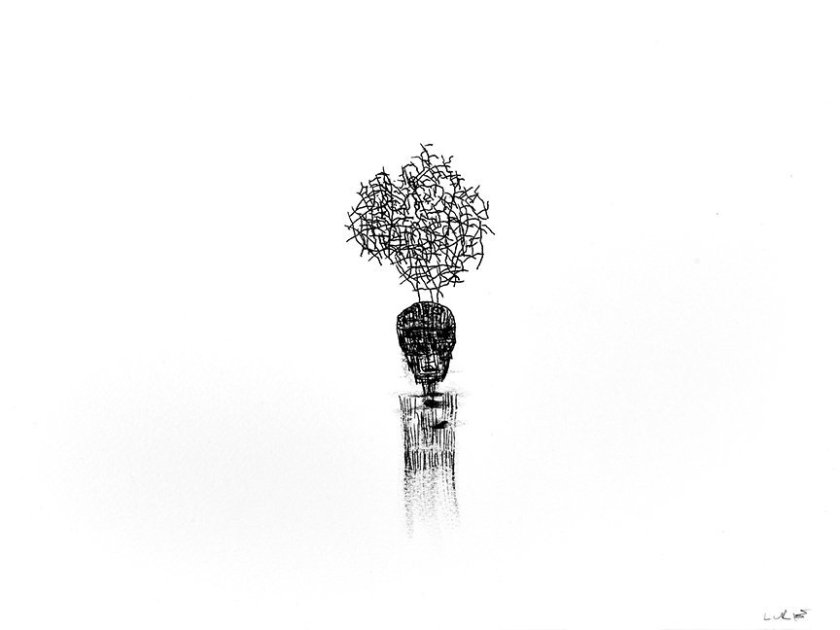
—“Please don’t think about barbed wire,” John Lurie
—“Please don’t think about barbed wire,” John Lurie
Light begins to seep through the windows. Waldman goes to sleep. He has an early flight to Switzerland to go cross-country skiing with Oleg Deripaska. I see this as an opening to leave. Depp looks for a security guard to call me a cab, but his knocking goes unanswered. So he walks me out.
“Thanks for coming,” says Depp. “This could be your Pulitzer.”
For the next 15 minutes, Depp tries to figure out how to open the gates to his mansion fortress. He clicks buttons and pushes the fence, but nothing budges. He is a lost boy who won’t find his way home before dark. I finally tell him I can shimmy over the fence. I clamber over and jump down. Through the bars we say good night.
“Take care, man,” he says. He goes silent for a moment. “Thank you for listening.”
He then turns around and walks back into his gilded prison and pushes open the heavy door. After a moment, it slams shut behind him.
—“Inside the Trials of Johnny Depp,” Stephen Rodrick
“‘…Literature is doomed if liberty of thought perishes. Not only is it doomed in any country which retains a totalitarian structure; but any writer who adopts the totalitarian outlook, who finds excuses for persecution and the falsification of reality, thereby destroys himself as a writer…. Unless spontaneity enters at some point or another, literary creation is impossible, and language itself becomes something totally different from what it is now, we may learn to separate literary creation from intellectual honesty. At present we know only that the imagination, like certain wild animals, will not breed in captivity.’”
—Orwell via Gessen
“…I think this is the job of writers right now: to describe what we do not yet see, or what we see but cannot yet describe, which is a condition almost indistinguishable from not seeing.
I want to find a way to describe a world in which people are valued not for what they produce but for who they are—in which dignity is not a precarious state.
I want to find a way to describe economic and social equality as a central value—a world in which inequality is, therefore, shrinking.
I want to find a way to describe prosperity that is not linked to the accumulation of capital.
Find a way to describe happiness as a public good, and the current pervasive crisis of mental health in a way that doesn’t involve the frames of norms and pathology, or the language of “fixing” people.
Find a way to describe a world without borders as we have known them—a world in which nation-states are not prized or assumed.
Find a way to describe learning that does not involve the warehousing and disciplining of children.
Find a way to describe justice whose objective is not retribution but restoration.
Find a way to describe politics that are genuinely participatory, that reflect the complexity and diversity of human experience, that avoid arbitrary divisions along party lines and emphasize coöperation around common goals.
Find an ever more complicated and evolving way to write about gender.
Find ways to describe kinship that is not the nuclear family or framed by the nuclear family. Find ways to tell the stories of friendship and community.
Find ways to describe a humanity that protects its planet, itself, and other creatures that inhabit the earth with us. Find words for reasonable and responsible coöperation.
Find a way to describe public space that is genuinely public and accessible, and include in this the virtual space of social networks and other media.
Above all, find a way to describe a world in which the way things are is not the way things have always been and will always be, in which imagination is not only operant but prized and nurtured.
And find a way to describe many other things that are true but not seen, seen but not spoken, and things that are not but could be.”
—“How George Orwell Predicted the Challenge of Writing Today”
“Today astronomers have released a photograph of Earth taken from very far away. From the rings of Saturn, actually. They sweep through the upper half of the frame, a vast tan curve against the cool obsidian of space. The Earth, meanwhile, isn’t how I remember it at all. It is reduced to a round blue bead, harmless and pristine, whereas up close, when photographed from the vantage of the moon, for example, it has always struck me as menacing and grave. From Saturn’s rings, however, the Earth is adorable. An ornamental button fallen from some stylish coat. One hardly feels sorry for it. The real object of sympathy, in the end, is the sacrificial satellite, sent out on a thirteen-year journey from which it will never return. Soon, I read, it will dive down to the dissipated surface of the planet at incinerating speeds, and so be reduced to dust. I wonder: Why not settle for the rings?”
—“Berlin Dispatches to Remember Me By,” J. Jezewska Stevens
“Rae was so angry at everybody by then she wouldn’t let anybody even try to speak to her. There was nobody. Nobody till Pete Tonely showed up with some of Ray’s business friends. He was so different. Younger, and really handsome. He didn’t hound her and paw her like Roy’s friends tried to, but she knew he noticed her a lot. The day after she turned eighteen and found that Sears Roebuck had turned her off from her warehouse job there, Pete had come over. He said something nice to her, and she started crying. She made herself stop crying right away, and they sat out on the back steps talking for a long time. He said, ‘Rae, I came over to tell you I’m pulling up stakes. Going to Denver. Tonight.’ She just sat there, dumb. He took her hand and said, ‘Listen, I want to take you out of this. If you want to come. I thought about going on to Frisco.’ She met him down at the train station that night.
The first year had a lot of excitement in it, and joy. She didn’t forget that. But poor Pete was always finding wonderful new friends and new prospects and then they didn’t pan out. He got fired, or he quit. As time went on, it seemed like nothing satisfied him anymore. He was never hard on her, but the joy was all gone out of it. A few months after they got anywhere, he was always talking about pulling up stakes. When they were in Chico, he’d met some man from a mining town who told him what a great job bartending was, and good money in the tips. And so she’d ended up in Goldorado. Still on the outside.”
—“Pity and Shame,” Ursula K. Le Guin
“Could a person who roasted three different kinds of apples for an autumn soup really be capable of suicide?”
—“Natural Light,” Kathleen Alcott
“The air is hazy. Our bands are playing. I regret having provided you only stray glimpses into my interior, with its changeful exaltations & deprivations, & its clues as to the secrets of my heart already vanishing. I recognize it’s all our task to argue not against Heaven’s hand but to bear up & steer onward. & I see that Hope calculates its schemes for a long & durable life, & presses us forward to imaginary points of bliss, & grasps at impossibilities, & so ensnares us all.”
—“Our Day of Grace,” Jim Shepard
“I don’t know if any of you have ever been big drinkers—like, daily, all-day drinkers—but there’s a sweet spot you hit, after you’ve chased away the hangover, when you start to feel balanced: all the happys are rich and bright and all the sads are deep and important. Your laughter is perfect and warm, and nobody quite understands the heartbreaking, tragic beauty of the world like you do. You become a virtuoso at feeling things. This sweet spot, which lasts for maybe two or three drinks, is what you end up chasing for the rest of the day, long after it is gone.
Garnett the Australian’s Bloody Marys pushed me and Tyler into the sweet spot. We talked about names for the three kids we were going to have and about landscaping details around the house we were going to buy and where Tyler’s workshop would go. We talked about traveling, about taking a cruise ship to Australia. We talked about everything we didn’t need to talk about and none of the things we did.”
—“Deadwood Soldiers Take a Cruise!” Jonny Diamond
“He had written out of loneliness or nostalgia, Min had told herself, trying to be kind in her dismissal. All she had to do was remain silent. But a silence stoically maintained, she now understood, did not give her any dignity. The next month, the month after next, he would send another e-mail, reminding her that she was never far from the girl he remembered. In his imagination she would still be young, pretty, and malleable. Her silence would do nothing to stop his boundless imagination.
That night, when Min failed to fall asleep, she opened the man’s e-mail from the night before. In a large font that she hoped would be easy for him to read, she typed, ‘Please stop writing me.’
Then, on second thought, she erased that, and wrote, ‘Go to hell.’”
—“A Flawless Silence,” Yiyun Li
 Health + Youth