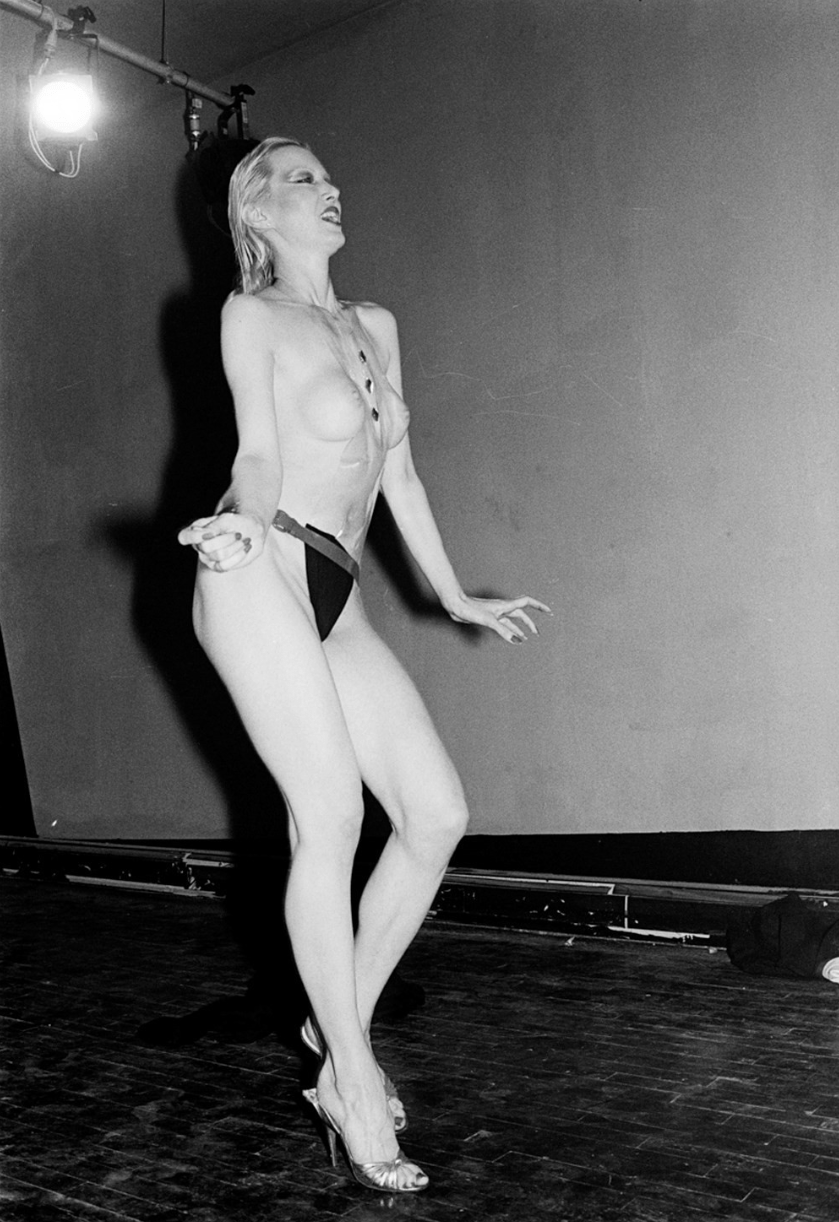
—Alan Tannebaum, New York in the 1970s
—Alan Tannebaum, New York in the 1970s
“You’ll see men cry breaking their hand in a fight, leather-assed Mexies and steel-town bruisers slumped on a corner stool with tears squirting out of their eyes. It’s not quite the pain, though the anticipation of pain is there—mitts swelling inside of red fourteen-ouncers and the electric grind of bone on bone, maybe it’s the eighth and you’re jabbing a busted lead right through the tenth to eke a decision. It’s the frustration makes them cry. Fighting’s all about minimizing weakness. Shoddy endurance? Roadwork. Sloppy footwork? Skip rope. Weak gut? A thousand stomach crunches daily. But fighters with bad hands can’t do a thing about it, aside from hiring a cornerman who knows a little about wrapping brittle bones. Same goes for fighters with sharp brows and weak skin who can’t help splitting wide at the slightest pawing. They’re crying because it’s a weakness there’s not a damn thing they can do for and it’ll commit them to the second tier, one step below the MGM Grand and Foxwoods, the showgirls and Bentleys.”
—“Rust and Bone,” Craig Davidson
“No one knows what they want until they do, and then they know nothing else. That’s what she thinks. And she’ll see to it that she loses nothing. In the end, she’ll lose no one. They’re all nicely mashed together now. Our history is inside us, and can’t every be extracted because it hasn’t been inserted, it lives between the membranes, saturating the soft tissue—it lurks within the cells, glowing gently, warmly, illuminating us from within.”
—“Pay Attention,” Peter Mountford
“Just looking at them, you can tell that they are both the type who could swim the Lazy River backward and all the way round. In fact, isn’t this what they have done? One is called Mariatou, the other Cynthia. For ten euros they will plait hair in cane rows or Senegalese twists or high-ridged Dutch braids. In our party, three want their hair done; the ladies get to work. The men are in the polytunnels. The tomatoes are in the supermarket. The moon is in the sky. The Brits are leaving Europe. We are on a ‘getaway.’ We still believe in getaways. ‘It is hard in Spain,’ Mariatou says, in answer to our queries. ‘Very hard.’ ‘To live well?’ Cynthia adds, pulling our daughter’s hair, making her yelp. ‘Is not easy.’”
—“The Lazy River,” Zadie Smith
“Saeed’s father then summoned Nadia into his room and spoke to her without Saeed and said that he was entrusting her with his son’s life, and she, whom he called daughter, must, like a daughter, not fail him, whom she called father, and she must see Saeed through to safety, and he hoped she would one day marry his son and be called mother by his grandchildren, but this was up to them to decide, and all he asked was that she remain by Saeed’s side until Saeed was out of danger, and he asked her to promise this to him, and she said she would promise only if Saeed’s father came with them, and he said again that he could not, but that they must go, he said it softly, like a prayer, and she sat there with him in silence and the minutes passed, and in the end she promised, and it was an easy promise to make because she had at that time no thoughts of leaving Saeed, but it was also a difficult one because in making it she felt she was abandoning the old man, and even if he did have his siblings and his cousins, and might now go live with them or have them come live with him, they could not protect him as Saeed and Nadia could, and so by making the promise he demanded she make she was in a sense killing him, but that is the way of things, for when we migrate, we murder from our lives those we leave behind.”
—Moshin Hamid, Exit West
The doctor says it’s an empty room in there
And it is
A pale sack with no visitors
I have made it and surrounded it with my skin
To invite the baby in
But he did not enter
And dissolved himself into the sea so many moons ago
I wait to see
Will the giant bean be in there another day
The women of the world say
Work harder!
The men in the world say
Work harder!
I work and work but I am an empty sack
Until I bleed the food all over the floor
Then I am once again with everything
Until the gods say, you’ve done well, good sir
You may die now
And the people who were asking me for favors all along
Knock on the coffin door
But I am gone, gone
—Dorothea Lasky
“The lightning cracked again, this time like it was right on top of us, feet away from arcing through the house, and her skin was white as stone and her hair waving, and I thought about the Medusa I’d seen in an old movie when I was younger, monstrous and green-scaled, and I thought: That’s not it at all. She was beautiful as Mama. That’s how she froze those men, with the shock of seeing something so perfect and fierce in the world.”
—Jesmyn Ward, “Sing, Unburied, Sing”
“‘That’s how it is, old girl. Kozma Ionitch is gone. He said goodbye to me. He is gone for no reason. Now, suppose you had a little colt, and you were mother to that colt, and at once that little colt died. You’d be sorry, wouldn’t you?’
“The mare munches, listens, and breathes on her master’s hands.”
—“Misery,” Anton Chekhov
“It was dusk in the streets already: as they drove on, the colored lights from the shops wheeled slowly across their faces, revealing them as strangers to each other. Valerie was thinking that she might need to summon all this effort of ingenuity one day for an escape of her own, dimly imagined, and that taking on the child made her less free. Robyn sat forward on the seat, tensed with her loss. Awkwardly, Valerie put an arm around her, to reassure her. She said not to worry, they would make new dolls, and better ones. Just for the moment, though, the child was inconsolable.”
—“Funny Little Snake,” Tessa Hadley
“During sex, he moved her through a series of positions with brusque efficiency, flipping her over, pushing her around, and she felt like a doll again, as she had outside the 7-Eleven, though not a precious one now—a doll made of rubber, flexible and resilient, a prop for the movie that was playing in his head. When she was on top, he slapped her thigh and said, ‘Yeah, yeah, you like that,’ with an intonation that made it impossible to tell whether he meant it as a question, an observation, or an order, and when he turned her over he growled in her ear, ‘I always wanted to fuck a girl with nice tits,’ and she had to smother her face in the pillow to keep from laughing again. At the end, when was on top of her in missionary, he kept losing his erection, and every time he did he would say, aggressively, ‘You make my dick so hard,’ as though lying about it could make it true. At last, after a frantic rabbity burst, he shuddered, came, and collapsed on her like a tree falling, and, crushed beneath him, she thought, brightly, This is the worst life decision I have ever made! And she marveled at herself for a while, at the mystery of this person who’d just done this bizarre, inexplicable thing.”
—“Cat Person,” Kristen Roupenian

 Health + Youth